
Two years ago, I published 5 Steps to Establishing an Effective Change Agent Network. I wrote about selecting the right people, setting expectations, providing support, and adjusting the approach. I also encouraged change agents to contribute beyond observing and reporting.
I still believe much of that advice has value. But I got something important wrong.
I was asking how to get more from a group of change ambassadors without questioning whether everything we expected belonged with that group in the first place.
After more than 30 large-scale transformations across more than a decade in change management and leadership, I no longer believe a stand-alone ambassador group can carry everything we routinely assign to it.
The answer isn’t to abandon ambassadors. It’s to stop confusing one group with an entire network.
Have we forgotten the a in SMART?
Consider the assignment. Navigate the change yourself. Deliver your day job. Help colleagues understand what’s happening. Gather feedback. Coach others. Encourage adoption. And influence people you have no formal responsibility for leading.
When that doesn’t work, we turn to managers and ask them to close the gaps, alongside their existing targets and responsibilities.
Neither approach creates more capacity. It just moves the burden.
We talk about SMART goals, but the ‘A’ matters: achievable, including within someone’s other commitment. A role can be clearly defined and still be unrealistic.
In my experience, this overloaded version of the ambassador model has fallen short more often than it has delivered what we needed. That isn’t a reason to question people’s commitment. It’s a reason to question the design.
We need distinct, achievable responsibilities that reflect people’s skills, authority, capacity, and existing work.
The lesson i had to learn twice.
Early in my career, during branch transformation at BMO, I saw the value of a dedicated coaching team supporting leaders. When that team was disbanded, I returned to the familiar change ambassador model I had been taught and seen repeatedly.
Years later, during an acquisition integration, we involved HR business partners (HRBPs) in supporting leaders through talent assessment, job mapping, and placement decisions. We hadn’t deliberately designed a change-coaching model. Its value became apparent through the work.
These were people whose existing responsibilities and relationships aligned with helping leaders navigate people-related change. They had a vested interest in the work succeeding.
But that support covered talent integration, while our ambassadors covered the broader integration.
A subsequent integration added more structured connections between senior leaders (middle management) and people leaders.
Still, something wasn’t right. How could we reliably understand the employee experience and support thousands of people without repeatedly overloading ambassadors, managers, or HRBPs?
That brought me back to the bank’s coaching team. We didn’t need another group to absorb everything. We needed to connect people with different responsibilities and equip each to make a realistic contribution.
Build the network around the work.
The principle is straightforward: start with what the change requires, then identify whose organizational role already aligns with that work.
This doesn’t exclude employees without coaching or leadership responsibilities. It means setting fair expectations with each group, rather than applying the same set of expectations for everyone. Existing ambassadors may contribute as employee representatives or take on other responsibilities where they have the skills and capacity.
The model I now recommend brings together what worked across those experiences and addresses the gaps that remained.
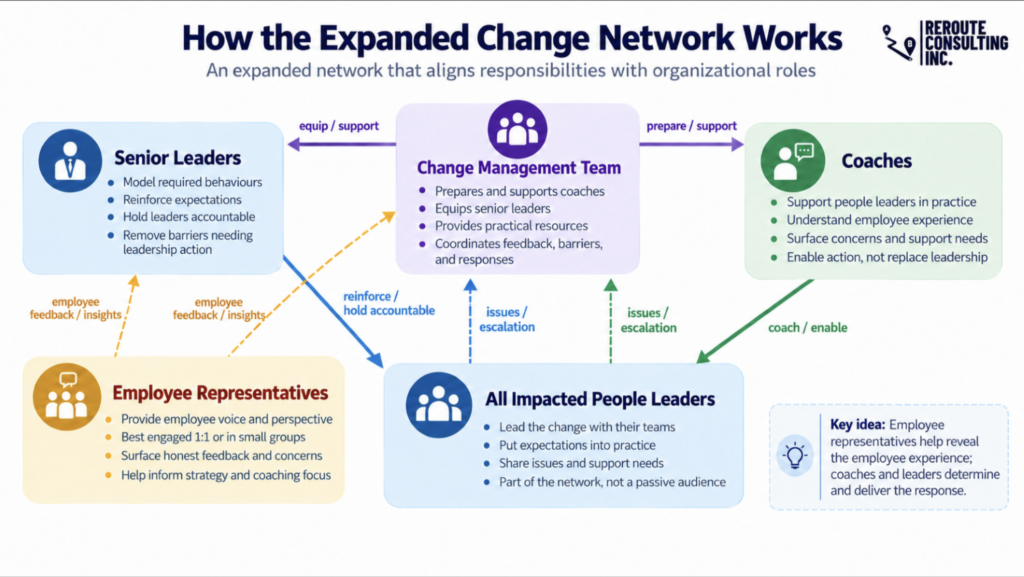
Senior leaders act as ambassadors. They model the required behaviours, reinforce expectations, hold their leaders accountable, and remove barriers requiring their authority. Endorsing a communication isn’t enough.
All impacted people leaders belong to the network. They translate the change into team-level action, respond to concerns, and identify support needs. They aren’t simply an audience receiving messages and being told to cascade them.
Coaches help leaders put expectations into practice. They support leaders through difficult situations, help them understand how employees are experiencing the change, and surface support needs. They strengthen leadership accountability; they don’t take it over.
The change management team enables and connects the network. It equips senior leaders, prepares coaches for the specific change, provides resources, and brings together insights to adjust the strategy and coordinate responses.
Employee representatives provide a direct connection to the employee experience. They help us understand confusion, concerns, and gaps in support. I’ve found one-to-one conversations and small groups particularly useful here. They don’t need to become substitute managers or coaches to make a valuable contribution.
This is where I’d revise my earlier advice: surfacing an issue is meaningful work. An employee representative shouldn’t also have to own its resolution to demonstrate their value.
The connections matter as much as the roles. For example, employee feedback might reveal that a difficult conversation isn’t happening. A coach could help the leader prepare; the change team could improve the guidance; a senior leader could address a competing priority. Someone must then communicate the response back to those who raised the concern.
That is a network, people adapt based on the information they receive and share with one another. They are connected instead of siloed, and their roles and responsibilities are complementary and achievable.
Coaching and change management belong at the same table.
HRBPs were effective because their roles were closely aligned with the support required for the change we were involved in. But alignment does not limit the capacity strain this work involves, and assigning the work to HRBPs doesn’t automatically create a fully equipped coaching function.
Moving the burden from managers to HRBPs risks recreating the same problem. My preference is a dedicated, trained leadership or change coach.
Dedicated doesn’t necessarily mean a new full-time position. It means deliberately securing the capability and capacity, internally, externally, or through a combination.
Companies like, Practica Learning, a firm I have worked with in the past, offer role-player coaches that can provide realistic workplace conversation practice and feedback, offering an external option for developing leadership skills. That support can form part of a broader coaching approach, alongside the ongoing support the change requires.
More fundamentally, I believe coaching professionals and change management professionals need to work much more closely together. For major business transformations, I no longer see that partnership as a nice-to-have. I consider both essential at the table from the beginning.
Together, they can connect what the transformation requires with the support leaders need to deliver it, and use what they learn to improve the approach.
the network needs the right conditions.
The strongest enablers will depend on the organization and the change. But I would start with leadership capability and the organization’s mindset.
Develop leaders, not just managers of tasks and targets. Invest in training and practice that help them listen, navigate uncertainty, and support people through difficult situations.
Build a culture of innovation, openness, and support, where people can question an approach, admit uncertainty, and raise concerns without being dismissed.
Middle managers, senior leaders, and sponsors must also be willing to participate, reinforce expectations, and make decisions about priorities and capacity.
Start there, then identify the gaps the particular change exposes. A network diagram won’t compensate for an organization that asks for honesty but doesn’t welcome it, or assigns responsibilities without making room for them.
be curious about the model, not just the people.
Think about the last network you established or supported. Where did it struggle? Were people unwilling, or were the expectations unrealistic? When something fell through, did you redesign the support or give someone more work?
In Path of Most Resistance, I wrote about empathy, curiosity, and openness, including empathy for those we ask to help deliver change. That curiosity has to extend to our own approaches.
The theory of a change network is compelling. The practical execution is where I’ve repeatedly struggled, and where I believe we need to be more curious.
Before recruiting another group of ambassadors, map the work. Who is best placed to do it? What support and capacity would make it achievable? And how will those people work together?
The question isn’t whether we need a change network. It’s whether we’ve actually built one.
To explore what that could look like in your organization, contact Reroute Consulting.
Podcast
leading change before the change begins: Mindsets, M&A & Transformation
Andrew and Perry explore why successful transformation doesn’t start with systems and processes—it starts with people. They discuss the importance of preparing leaders, establishing the right mindsets and behaviours, and creating the conditions for change before a transformation begins.
continue exploring change management
Revisit Andrew’s earlier perspective on building and supporting change agent networks, and see how his thinking has evolved.
Explore the importance of empathy, curiosity, and openness when navigating organizational change.

